By Rebecca Yakubu Akatue, PhD
On 5th December 2026, The Gambia will hold a presidential election that is likely to attract attention well beyond West Africa. The election will determine who leads the country for the next five years, but its significance extends beyond the contest among political parties and candidates. It will also provide another opportunity to examine one of the world’s most distinctive electoral systems: The Gambia’s marble voting mechanism.
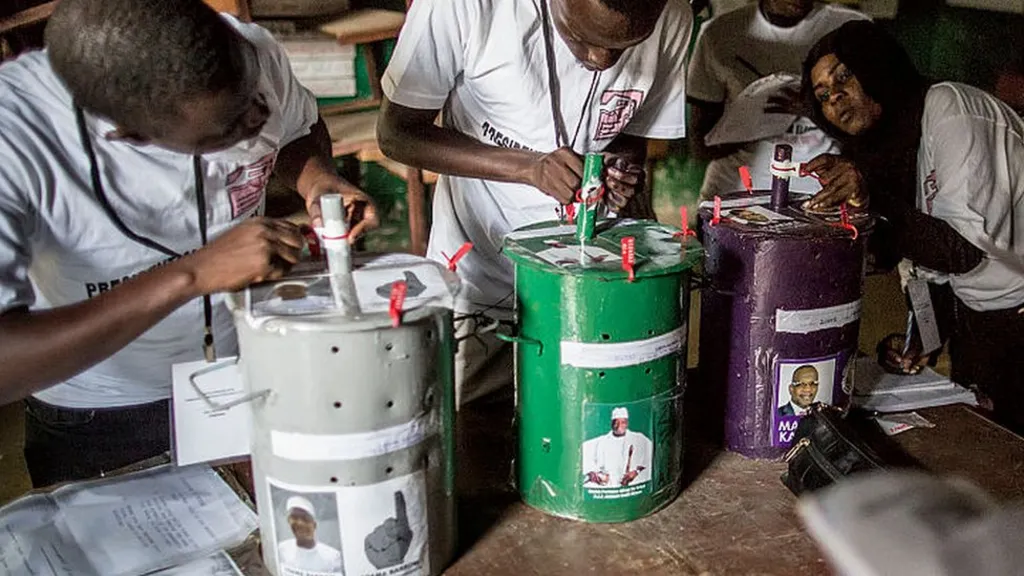
At a time when elections around the world are increasingly shaped by electronic voting technologies, cybersecurity threats, artificial intelligence, digital disinformation and concerns about the integrity of electoral data, The Gambia continues to conduct its elections through an essentially analogue system. Instead of paper ballots or electronic voting machines, voters use a single glass marble or token, which is deposited into a colour-coded metal drum bearing the photograph and symbol of the preferred candidate. A bell inside the drum provides an audible indication that the token has been deposited.
The distinctive character of The Gambia’s voting system lies in the relationship between its simplicity and its institutional purpose. The system was introduced in the period preceding the 1960 General Elections, principally because a large proportion of the electorate was unable to use conventional written ballots. The electoral authorities have also associated the system with the need to reduce opportunities for electoral fraud.
The marble therefore began not as an attempt to preserve tradition, but as a practical response to a democratic problem: how to make voting accessible to citizens regardless of literacy. That original purpose remains important because it places participation at the centre of the system.
The mechanics are remarkably straightforward. After verification, the voter receives a marble or voting token and places it in the drum representing the chosen candidate. The sound produced when the token enters the drum provides an immediate indication that the vote has been cast. The IEC’s current voting procedures retain this process, with polling officials listening for the sound of the token entering the selected drum.
The simplicity of the mechanism is also its institutional strength. There is little technological mediation between the voter and the act of voting. The voter does not have to navigate a touchscreen, understand a digital interface or rely on a computer to translate a selection into a recorded vote. The act is physical, direct and easily understood.
This does not mean that the system is without rules or safeguards. Voters must meet established eligibility requirements, present their voter cards and have their details verified before receiving a token. The process is administered by polling officials and supported by party agents and observers.
The system also incorporates an important element of public verifiability. The physical nature of the ballot mechanism makes important stages of the process observable to election officials, candidates’ agents and observers. The counting process is conducted through established procedures designed to make the outcome verifiable.
This combination of physical voting, audible confirmation and observable counting helps explain why the marble has acquired significance beyond its original administrative purpose. It has become familiar to generations of Gambian voters and is now associated with the country’s electoral identity.
Yet familiarity should not be confused with perfection. The system operates within a wider electoral framework whose credibility depends on voter registration, polling-station administration, political competition, counting procedures, electoral observation and the independence of electoral institutions. The marble can strengthen the integrity of the voting act; it cannot independently guarantee the integrity of the entire electoral system.
This distinction is central to the concept of marble idiosyncrasy. The argument is not that the marble itself is inherently superior to other voting technologies. Rather, its significance lies in the institutional qualities it demonstrates: participation without unnecessary complexity, visibility without compromising secrecy, and verification without requiring citizens to understand sophisticated technology.
That is what makes the Gambian experience particularly relevant at a time when electoral systems across the world are becoming increasingly technological. The question is not whether an election uses the newest available technology. The more fundamental question is whether citizens can participate confidently and whether the system provides credible means of establishing that their votes have been properly recorded and counted.
The marble, in this sense, is more than a voting instrument. It is a reminder that democratic innovation does not always mean adding technology; sometimes it means designing institutions around the realities and capacities of the people they serve.
The marble as an electoral institution
The history of The Gambia’s marble voting system is important because it illustrates how an administrative mechanism can gradually acquire institutional meaning. The system emerged in the period surrounding the country’s first elections under universal adult suffrage and has subsequently remained part of Gambian electoral practice through independence, the First Republic, military rule and the post-1997 constitutional order.
Over time, the marble system has moved beyond its original practical purpose. It has become familiar to successive generations of voters and is now closely associated with the way Gambians experience electoral participation.
This institutional continuity matters. Electoral systems do not derive legitimacy solely from their technical design; they also derive it from citizens’ familiarity with procedures and their confidence that those procedures will be applied consistently. The continued use of the marble system has given Gambian voters a form of procedural familiarity that is difficult to replicate simply by introducing a new technology.
The marble has therefore become more than a voting instrument. It has acquired a place within The Gambia’s democratic and national identity.
This continuity, however, should not be interpreted as evidence that The Gambia’s electoral institutions have remained unchanged. The wider administration of elections has evolved considerably, including voter registration, electoral management, observation, political-party regulation, civic participation and the use of information technologies. The marble remains the central mechanism through which the vote is physically cast, but it operates within a broader institutional architecture that continues to develop.
The distinction is significant.
Institutional continuity should not be confused with institutional stagnation.
A trusted electoral mechanism can remain in place while the systems surrounding it are progressively strengthened.
The experience also demonstrates that an electoral institution can evolve without necessarily abandoning the mechanism that citizens already understand. The Gambia can strengthen voter registration, election information, logistics, cybersecurity, data protection, accessibility, electoral monitoring and results management while retaining a voting method that has accumulated considerable public familiarity.
The marble system therefore offers a different way of thinking about electoral innovation. Innovation does not necessarily require replacing an existing system with something technologically newer. It can also involve identifying what works, understanding why it works, and modernising the institutional architecture around it without unnecessarily destroying the source of public confidence.
This is perhaps the most important institutional lesson of the Gambian experience. The value of the marble is not simply that it has survived for decades. Its value lies in the institutional trust and familiarity accumulated through that continuity.
That accumulated trust should therefore be treated as an asset in any future electoral reform process. If The Gambia eventually decides to introduce more advanced technologies into the voting process, reform should begin not with the question of what technology can replace the marble, but with the more fundamental question of what institutional qualities must not be lost when the marble is replaced.
The 2026 electoral nexus: Procedural legitimacy and the crisis of substantive governance
The 5th December 2026 presidential election marks a critical juncture in The Gambia’s post-authoritarian trajectory. Coming a decade after Adama Barrow’s victory over Yahya Jammeh, the election is more than a routine contest for political office. It provides an opportunity to assess whether the democratic opening that followed the 2016 election has translated into durable institutional and political change.
Barrow’s accession to power followed a remarkable political transition. In the 2016 presidential election, he emerged as the opposition coalition’s candidate and defeated Jammeh, whose attempt to reject the electoral result subsequently triggered a regional political crisis. The transition that followed generated expectations that extended beyond the replacement of one president by another.
The opposition coalition that supported Barrow brought together several political parties around a broader programme of democratic reform, institutional renewal and political change. The post-2016 period subsequently saw efforts to reform the constitutional order and address questions of executive power and institutional accountability.
Consequently, the 2026 election presents a challenge deeper than voting integrity alone. While the nation’s unique marble-and-drum voting system provides a transparent and familiar mechanism through which citizens express their political preferences, the ultimate test of democratic consolidation lies in what happens before and after those marbles drop.
The political environment has changed considerably since 2016. The original transition coalition has fragmented, new political actors have emerged, and political realignments have developed around competing visions of national leadership and development. The 2026 election is therefore not simply a choice between candidates; it is also an assessment of the direction of The Gambia’s post-Jammeh democratic experiment.
This dynamic highlights what may be described as the procedural-substantive legitimacy nexus.
Procedural legitimacy concerns whether elections are conducted fairly, transparently and according to accepted rules. It encompasses voter registration, access to the ballot, the conduct of polling, counting, results management and mechanisms available for resolving electoral disputes.
Substantive legitimacy, by contrast, concerns whether democratic institutions deliver accountable governance, political responsiveness, economic opportunity, effective public services and meaningful improvements in citizens’ lives.
This distinction is important for The Gambia. A credible election establishes a government’s democratic mandate, but it cannot by itself guarantee effective governance. An election may be transparent and competitive while the government that emerges subsequently fails to meet citizens’ expectations concerning employment, public services, institutional reform or accountability.
This creates the possibility of a disillusionment paradox: citizens may retain confidence in the process through which they cast and count their votes while becoming increasingly dissatisfied with what those votes produce in terms of governance outcomes.
The distinction also places responsibility beyond the electoral management body. Political parties and candidates must provide meaningful choices, articulate credible policy alternatives and remain accountable between elections. Democratic consolidation cannot depend exclusively on the integrity of election day; it requires institutions capable of sustaining accountability throughout the electoral cycle.
The 2026 election will therefore test two dimensions of democratic strength simultaneously. Operationally, it will test the resilience of The Gambia’s distinctive electoral architecture. Politically, it will test whether democratic institutions can translate citizen participation into responsive and effective governance.
The central question is consequently not merely who wins the marble vote, but whether the mandate produced by that vote can generate the institutional performance and public confidence required for democratic consolidation.
You can read the full article at https://standard.gm/the-marble-idiosyncrasy-trust-and-the-future-of-elections-in-the-gambia/