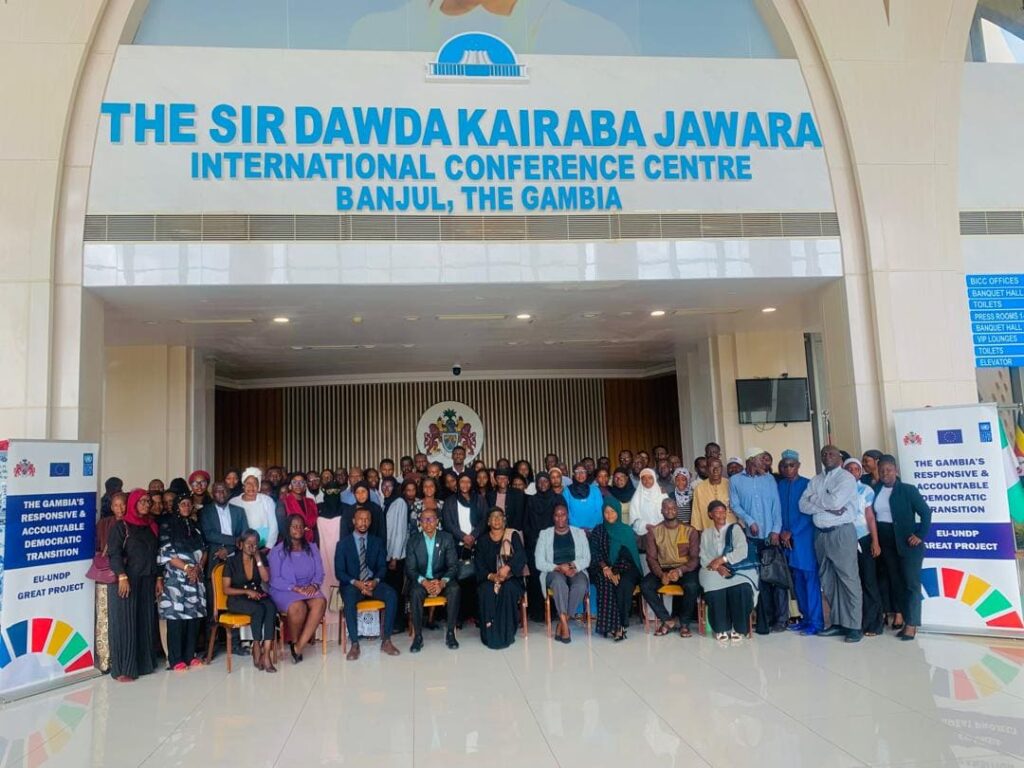
A total of 166 court officers recently benefitted from an intensive two-days training on the Revised High Court Rules.
Held at the Sir Dawda Kairaba Jawara International Conference Centre in Bijilo, the training, supported by the EU-UNDP GREAT Project, brought together registrars, court clerks and district tribunal staff from across the country.
The objective is strengthen understanding of the revised rules and equip frontline judiciary staff to apply the new procedures effectively in the administration of justice.
James Moniba, Manager of the EU-UNDP GREAT Project, said the training aligns with the EU 2023-2027 framework, the UNDP Country Programme 2024-2028 and Sustainable Development Goal 16 on peace, justice and strong institutions.
He said the training forms part of UNDP’s broader support for justice sector reform, including investments in judicial infrastructure, institutional capacity development, digital case management, legal aid services, alternative dispute resolution and stronger sector-wide coordination.
“Together, these investments are helping to make the justice sector more efficient, responsive, transparent and accessible to all Gambians,” Moniba said.
He noted that over the two days, participants received practical training through interactive sessions led by senior lawyers, aimed at strengthening procedural compliance, improving registry efficiency and case management, and reducing delays within the justice system.”
UNDP emphasised that timely hearings and judgments depend not only on judges, but also on efficient case flow, consistent application of procedural rules and effective service to citizens. Properly processed files, well-managed registries and reduced delays are essential to strengthening public confidence in the Judiciary and upholding the rule of law,” he said.
He commended the Judiciary of The Gambia for its ongoing institutional reforms and thanked the European Union for its continued support for governance and rule of law initiatives.
Speaking on behalf of the Chief Justice, Justice Sainabou Wadda-Ceesay of the Court of Appeal said the 2026 High Court Rules seek to overhaul court procedures by addressing procedural gaps and responding to the evolving legal landscape.
“First, the overall objective of the rules is to promote efficiency, uniformity and improvement in the quality of court administration,” she said, adding that the administration of justice is a specialised skill and the effectiveness of the new rules must be matched with staff who possess requisite skills in court administration, court management and knowledge of substantive and procedural law.
Sanna B Manneh, High Court Clerk, said the training will help him manage judicial processes more effectively.
“This is something that we have been yearning for. This kind of training will really help us adjust ourselves to be able to practically do our work,” he said.
Acting President of the Judicial Staff, Abu Marigo, welcomed the initiative, highlighting its importance in strengthening the capacity of court staff and enhancing justice delivery.
Participants were urged to actively engage in the sessions and apply the knowledge gained to their daily responsibilities, with emphasis on building an efficient, transparent, accountable and people-centred Judiciary.
The initiative is expected to accelerate effective implementation of the Revised High Court Rules and drive broader transformation of The Gambia’s justice system.